

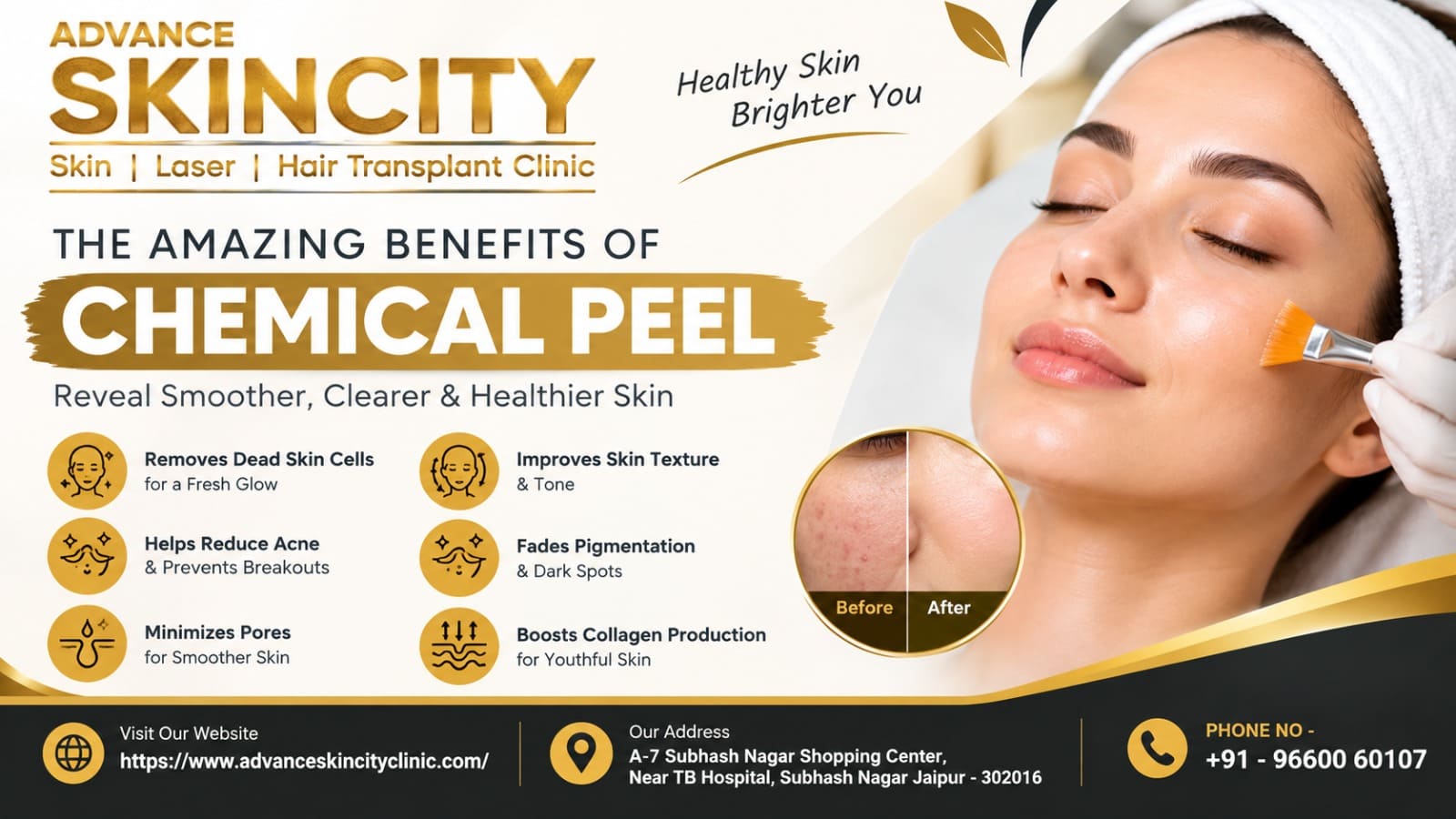
Chemical peels benefits remove top layers of the skin using chemicals. This treatment replaces those layers with fresh, healthy skin. Chemical peels are done custom in Jaipur, India by Dr. Rebari at his clinic, Advance Skincity Clinic, based on your skin type and skin goals.
Irritating acne marks, damaged skin, and fine lines cause people to dislike their appearances. While many skin care products are advertised to help these issues, chemical peels done by a professional produce visible results that other products cannot offer. Many beauty treatments become out-dated, but chemical peels have withstood the test of time. Renewal is achieved from within the skin after surface level renewal is stimulated by this treatment.
After types of chemical peels and what they treat, this article will focus on the process of a chemical peel and what benefits that has resulted in the treatment being loved by both dermatologists and clients.
What Are Chemical Peels?
Chemical peels are done by applying a chemical that causes, in a controlled manner, damage to the skin surface so that the outermost layers can be removed. This treated skin will begin to peel over several days, showing off a new healthy skin layer with an even surface and an attractive color.
Chemical peels may be used on the face, neck, chest, and hands. The strength of the solution dictates how deep the peel penetrates the skin. Professional advice is essential. Dr. Ramesh Rebari at Advance Skincity Clinic evaluates a patient’s skin type and assesses the skin’s tone and concerns before determining the strength of the peel.
What Are the Different Types of Chemical Peels?
Chemical peels may be classified into three groups based on the depth of the skin penetration. Select superficial peels if your goal is to deal with skin dullness, and you want to take very little downtime. If your goal is to take care of signs of aging or pigment changes and cysts and you can take longer downtime, go for medium or deep peels.
Superficial Peels
Superficial peels consist of low concentrations of AHAs and give the least amount of downtime. As a result, this kind of peel is best for patients who have not had much experience with chemical peels, or who need rapid skin rejuvenation before a social event.
Medium Peels
These peels utilize TCA and penetrate the skin to a greater extent. Because of this, they address issues of more concern including pigment changes and wrinkles. The recovery process for this level of peel consists of peeling for a number of days.
Deep Peels
Deep peels employ stronger agents, like phenols, to reach even deeper skin layers. They are reserved for the most severe damage cases, such as deep wrinkles and bad scarring. Not only do deep peels take the longest to heal from, but they should also only be performed by a board-certified dermatologist.
What Conditions Does a Chemical Peel Treat?
A chemical peel can address many skin concerns and is a good option for many patients. Typical concerns addressed by chemical peels include: scarring from acne, dark spots from discoloration (i.e. melisma), fine lines and wrinkles, uneven texture, and dull skin.
What Are the Benefits of Chemical Peels?
Chemical peel benefits result in healthier skin for the long run.
Healed skin is smoother and has an even texture. It becomes noticeable to patients how soft and silky their skin feels after a chemical peel.
Benefits of Chemical Peels
Private practices and spas offer chemical peel procedures for post-acne mark fading. Chemical peels also help with cell turnover, meaning they can help treat scars and pigmentation. Upping cell turnover means collagen levels also start to increase. Collagen is one of the skin’s main building blocks and is essential for the production of healthy, bouncy, and young-looking skin. It also helps reduce fine lines and wrinkles.
Look Better, Feel Better
Peel procedures take far less recovery time than many cosmetic surgeries, and usually don’t require significant downtime. Chemical peels also help even and improve skin complexion, and most patients show visible results.
Personalization Pays Off
Since chemical peels have a range of strengths, the strength of the formula can be based on how strongly the treatment needs to be for a certain skin issue. Peel medium strength can effectively treat sensitive skin, while peel deeper strengths can effectively treat more aggressive skin issues.
In Conclusion
Chemical peels are some of the best means to fade and improve a variety of skin concerns, from pigmentation to acne scarring and fine lines. Improving and treating skin complexion through decades of dermatology practice is why so many patients continue to use chemical peels.
For a personalized chemical peel to improve skin complexion in Jaipur, contact Dr. Ramesh Rebari at Advance Skincity Clinic. He’ll analyze your skin and determine the best type of peel strength for your skin issues, all while improving the appearance of your skin.
Questions That Are Often Asked
What is the average wait time for results after a chemical peel?
Mild and moderate chemical peels can begin to show visible results after only a few days, while deeper peels can take up to two weeks for the regenerated and fully healed skin to show results.
What level of discomfort do patients experience during the procedure?
Most patients report feeling only a mild tingling and warmth. However, deeper peels will probably cause some discomfort, which is why you should always have some kind of supervision.
What is the approximate cost for the service?
Depending on the location and the depth of the peel, cost can vary. However, the Advance Skincity Clinic will give you an exact quote based on the treatment you need during your consultation.
What is the criteria for someone to NOT receive a chemical peel?
People that have active skin infections, or open wounds, or conditions such as eczema, need to see a dermatologist before a chemical peel procedure is considered.
What are some alternate procedures to a chemical peel?
Microdermabrasion or laser resurfacing or topical treatments with retinoids may be considered as alternatives. Your skin concerns and the results you want to achieve in combination with the amount of downtime you can take will help to determine which procedure is the most appropriate for you.
